
Monday morning, you're unstoppable. You've got a new chore chart on the fridge, a meal plan taped to the cabinet, and a laundry schedule that assigns each day of the week a specific load. You've prepped the diaper bag, organized the toy bins, and written "15-minute reset" in your planner for every evening. You are going to be the kind of mom who has a system.
By Wednesday, the chore chart is buried under a stack of preschool artwork. The meal plan has been abandoned twice because the baby cluster-fed through dinner prep and you ordered pizza. The laundry schedule is a distant memory, and the toy bins have somehow reproduced into a larger mess than before. You're not sure what happened, but you feel like you failed.
Here's what actually happened: your system was designed for a version of your life that doesn't exist. It was built for Monday-morning energy, not Wednesday-night exhaustion. And when it collapsed, it wasn't because you're undisciplined or lazy. It was because the system demanded more from you than a tired parent with two young children can reasonably give.
I've watched this cycle play out in dozens of households — including my own. I've created systems that fell apart by Wednesday. I've also learned what separates the systems that stick from the ones that collapse. It's not willpower. It's design. Let me talk about why most family systems fail by Wednesday, and what to do differently.
The Monday Illusion
Monday is the easiest day to start a system because Monday comes with a particular feeling. It's the start of a new week. You've had whatever rest the weekend could offer — even if it wasn't much. You feel determined. You feel capable. You believe that this week will be different.
That feeling is real, but it's also temporary. By Monday afternoon, the baby has already had three diaper changes and a blowout. By Monday evening, your toddler has refused dinner and thrown a cup on the floor. By Tuesday, you're running on less sleep and more caffeine. By Wednesday, the Monday feeling is gone, and all that's left is the system — which now feels like one more thing you have to do.
The mistake isn't starting on Monday. It's building a system that only works with Monday energy. A system that requires you to feel motivated every single day is a system that will fail the moment your motivation dips — which, for most tired parents, is somewhere around Tuesday at 4 p.m.
Why the Systems Collapse
They're Too Complicated
The average family system I see created on a Sunday night has somewhere between seven and twelve steps. It assigns different tasks to different days. It has categories and subcategories. It requires you to remember what you're supposed to do on which day and in what order. That's a lot of cognitive load for a brain that's already running on broken sleep.
When a system is too complicated, it doesn't just fail once — it fails repeatedly, and each failure makes you less likely to try again. The system becomes associated with guilt and frustration, so you avoid it. By Wednesday, you're not just off track; you're actively avoiding the chart on the fridge because looking at it makes you feel bad.
They Assume Nothing Will Go Wrong
Every family system I've ever seen collapse had one thing in common: it assumed a normal week. It assumed the baby would nap at the usual times, the toddler wouldn't get sick, the car wouldn't need a sudden repair, and you wouldn't have a night where everyone was up at 3 a.m. with a stomach bug.
But weeks with young children are never normal. There's always a disruption — a growth spurt, a sleep regression, a fever, a meltdown, a spilled gallon of milk. A system that can't flex around disruptions will break at the first sign of one. And by Wednesday, you've usually hit at least one disruption.
They Depend on One Person
In most households, the family system is really the mother's system. She's the one who created it, she's the one who maintains it, and she's the one who feels guilty when it falls apart. If she has an off day — if she's sick, exhausted, or just needs to not be in charge for one afternoon — the whole system stalls.
A system that depends entirely on one person is not a system. It's a personal project with extra steps. And personal projects are the first things to go when that person is running on empty.
The Systems That Actually Stick
After years of watching family systems fail by Wednesday, I started noticing the ones that didn't. They shared a few key qualities, none of which had anything to do with color-coded charts or complicated schedules.
They Have Three Steps or Fewer
The best family systems are almost embarrassingly simple. They do one thing, and they do it without requiring you to remember a complicated sequence. Here are some examples from real homes:
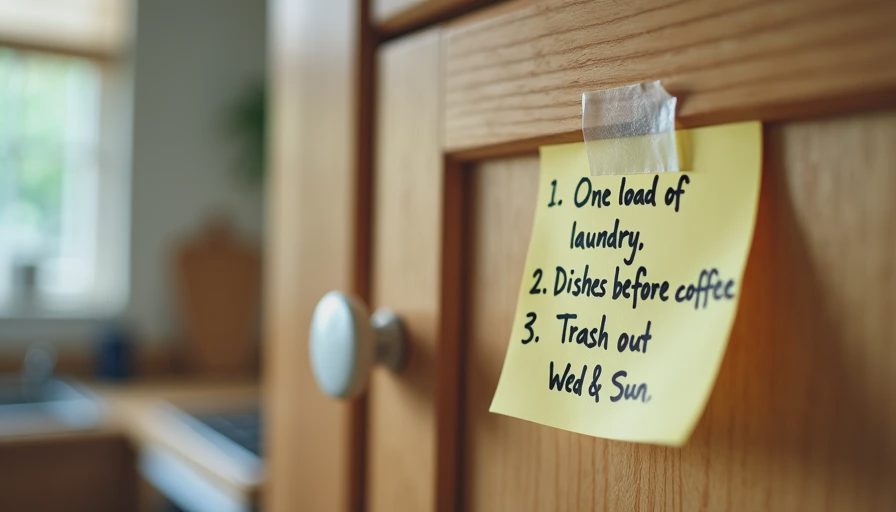
The "one load a day" laundry rule: Every morning, start one load of laundry. That's it. No Monday-towels, Tuesday-kids'-clothes schedule. Just one load, every day, whenever you think of it. If you miss a day, you do two loads the next day. The system survives because it's almost impossible to fail at it.
The "dishes before coffee" rule: Before you make coffee in the morning, empty the dishwasher or wash the few dishes in the sink. It takes five minutes and gives you a clear counter for the day. The anchor is the coffee — you're not going to skip coffee, so you won't skip the dishes.
The "trash goes out on Wednesdays and Sundays" rule: Two trash days a week, no matter what. If the trash isn't full, you take it out anyway. The consistency matters more than the fullness.
Each of these systems has one step. No categories. No subcategories. Just one small action tied to an existing routine or a specific day. That's why they survive.
They're Built Around Anchors
A system sticks when it's attached to something you already do every day without thinking. Coffee, brushing your teeth, feeding the baby, putting the kids to bed — these are anchors. A good family system hangs off an anchor instead of floating in the air.
For example: instead of "do a 15-minute reset every evening," try "after the kids are in bed, set a timer for 10 minutes and clear the kitchen counter." The anchor is bedtime. When bedtime happens, the reset happens. You don't have to remember to do it separately; it's attached to something that's already happening.
I've seen this work with everything from laundry to meal planning to toy cleanup. The question to ask is: What am I already doing every day that I can attach this to?
They Assume Interruptions
A good family system is built with the expectation that things will go wrong. It has slack. It has a "what if" built in.
The "one load a day" laundry rule has slack because missing a day doesn't break it — you just do two loads tomorrow. The "dishes before coffee" rule has slack because if you're too tired to do dishes, you can run the dishwasher instead. The "trash goes out twice a week" rule has slack because even if you forget one day, there's another trash day coming.
Systems with slack don't collapse when disrupted. They bend and then recover.
They Involve Everyone (Even a Little)
The systems that last are the ones where other family members have some role. Not a big role — a small, age-appropriate one. A toddler can put their toys in a basket before bed. A partner can empty the dishwasher. A four-year-old can put their own shoes by the door.
When everyone has even a tiny part, the system no longer depends entirely on one person. It becomes a family rhythm instead of a mother's private burden. It also teaches your children that the household belongs to everyone, not just Mom.

How to Fix a System That Keeps Failing
If you've got a system that fails by Wednesday every single week, here's what I recommend.
Cut It in Half
Whatever your system is, remove half of it. If it has six steps, keep three. If it has four categories, keep two. If it requires three different checklists, keep one. Your system is failing because it's asking too much. Cutting it in half makes it doable.
Attach It to an Anchor
Find the one thing you do every day without thinking, and attach your system to it. Not "do laundry" floating in the air, but "start one load before breakfast." Not "clean the living room" as a vague intention, but "put the toys in the basket right before the bedtime books." The anchor is what keeps the system alive when your motivation dies.
Give It Slack
Build a "missed a day" plan into your system. Tell yourself in advance: If I miss a day, I'll do it the next day. That way, missing a day doesn't feel like failure — it feels like part of the design. Systems without slack make you quit the first time you slip. Systems with slack absorb the slip and keep going.
Let Yourself Change It
A system that worked for you at one stage might not work at another stage. When your baby starts solids, your kitchen system needs to change. When your toddler drops their nap, your afternoon rhythm shifts. A good system evolves. If something isn't working anymore, it's not a moral failure to change it. It's common sense.
What I've Learned From My Own Failed Systems
I've created and abandoned more family systems than I can count. The chore chart with the sticker system. The meal-planning binder with the laminated pages. The laundry schedule with the different days for different colors. All of them failed by Wednesday, sometimes by Tuesday afternoon.
The system that finally stuck in my house is embarrassingly simple: every night, after the kids are in bed, I spend ten minutes putting the kitchen to bed. I clear the counter, start the dishwasher, and fill the water reservoir on the coffee maker. That's the whole system. It has survived sleep regressions, stomach bugs, toddler meltdowns, and the general chaos of life with two children.
Why does it work? Because it's small. Because it's attached to bedtime, which happens every night whether I want it to or not. Because it has slack — if I'm too exhausted, I just clear the counter and skip the rest. Because it makes tomorrow morning easier, and I can feel the difference.
That's the test of a good family system: does it make tomorrow easier without making today harder? If the answer is yes, it will probably survive the week. If the answer is no, it will fail by Wednesday no matter how pretty the chart is.
You do not need a perfect system. You need one that works at 3 a.m. — and at 7 a.m. on a Wednesday when the Monday motivation is long gone and all you have left is the habit itself.
Start with the part that makes tonight easier. Let the rest go.


No notes yet — write the first one.