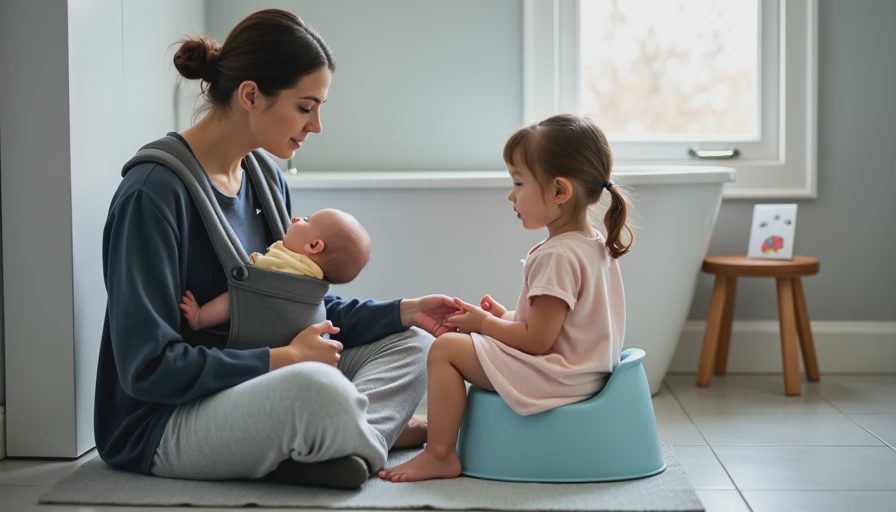
There's a particular kind of exhaustion that comes from sitting on the bathroom floor while your toddler sits on the potty and your newborn cries in the other room. You're trying to be present for one child while your body physically aches to go to the other. You're watching for a pee that may or may not come, while listening to a cry that definitely will not stop. If you're in the middle of potty training while caring for a baby, you already know: this is not the clean, focused process the books describe.
I've helped many families through this exact season, and I've lived it myself — my daughter was two and a half when my son was five months old, and potty training with a baby in the house nearly broke me. What I learned, from my own mistakes and from watching other mothers navigate the same impossible split, is that potty training with two kids requires a completely different approach. You don't need more willpower or a stricter chart. You need a plan that assumes your attention will be divided from the start.
Why Potty Training With a Baby Feels Different
Your Attention Is Always Split
Potty training, at its core, is about presence. You watch for cues, you offer frequent potty breaks, you respond quickly when the pee dance starts, and you stay calm through accidents. That's already a full-time job. Now add a baby who needs to be fed every two to three hours, changed regularly, held constantly, and soothed unpredictably. The math doesn't work. You cannot give both children 100% of your attention at the same time, and pretending otherwise only sets you up for guilt.
The Baby's Needs Don't Wait for the Potty
There will be moments when your toddler is finally relaxed on the potty, about to go, and the baby starts screaming from the crib. You have to choose: stay and lose the moment, or go and lose the moment. Neither choice feels good. I remember one afternoon when my daughter was mid-pee on her little potty and my son woke up wailing. I stayed with her, whispered "you're doing great," and waited until she finished before running to him. She peed. We celebrated. But the guilt of those two minutes of crying stayed with me for hours. That's the reality of potty training with a baby. You're constantly making impossible choices, and the best you can do is choose and move on.
Before You Start: Readiness Matters More Than Age
The single most important factor in successful potty training with a baby is waiting until your toddler is genuinely ready. Potty training a child who isn't ready will create power struggles, regressions, and more laundry than you can imagine. Here are the signs I looked for with my own daughter and with the families I supported.
The Readiness Signs That Actually Matter
Showing interest in the potty. Your toddler follows you to the bathroom, wants to sit on the potty, or asks questions about what happens there. Curiosity is the foundation.
Staying dry for longer stretches. If your toddler can go two hours or more without wetting a diaper, their bladder muscles are developing the control needed for training.
Noticing wet or dirty diapers. Pulling at a wet diaper, asking to be changed, or hiding to poop are all signs that your child is becoming aware of bodily sensations.
Following simple directions. If your toddler can follow a two-step instruction like "go get your shoes and bring them to me," they likely have the cognitive capacity for potty training.
Having words or signs for bathroom needs. Your toddler can tell you — or signal — that they need to go, or that they're already wet. This communication is essential because you can't always be watching.
What Doesn't Matter
Age alone is not a reason to start. Some children are ready at two; others are closer to four. Both are normal. Your mother-in-law's opinion, your friend's bragging about her eighteen-month-old, and the preschool's requirement don't matter either. What matters is your child's actual readiness — and your own capacity. Because potty training with a baby demands more from you, you may need to wait a little longer than you would with just one child. That's not a delay; that's wisdom.
The Low-Pressure Approach That Works With a Baby
If your toddler is showing readiness signs and you decide to move forward, here's the approach I recommend. It's not a three-day intensive. It's a slow, steady process designed for divided attention.
Start With Potty Exposure, Not Potty Training
Before you commit to full training, spend a week or two normalizing the potty. Put a small potty chair in the bathroom or living room and let your toddler sit on it fully clothed. Read potty books together. Let them flush the toilet for you. The goal isn't to catch anything — it's to make the potty feel safe and familiar.
This matters even more when there's a baby in the house, because your toddler is already processing a huge life transition. Adding pressure to perform on the potty can feel like one more expectation they might fail. So take it slow. Let the potty become part of the furniture before you ask anything of it.
Use Pull-Ups or Training Pants Without Guilt
The hardcore potty training camps will tell you to skip pull-ups and go straight to underwear. Their reasoning is that pull-ups feel like diapers, so toddlers don't learn to recognize wetness. That has some truth — but when you're also caring for a baby, practicality matters. Underwear means accidents, and accidents mean cleanup, and cleanup requires time and hands that the baby is already using.
So here's my permission: it's okay to use pull-ups as a bridge. You can do "potty sitting" times while your toddler wears pull-ups, then move to underwear when you have more capacity for accidents. One approach that worked for several families I know: use underwear in the morning when you're freshest, and pull-ups in the afternoon and evening when the baby's needs peak. This gives your toddler real practice without drowning you in laundry.
The "Every Hour" Invitation
When you're ready to actively train, start with a simple rhythm: invite your toddler to sit on the potty every hour or so, plus after meals and before outings. Don't force it. Don't beg. Just make it a normal part of the day — like brushing teeth or putting on socks.
The key word is invite. You're not wrestling anyone onto the potty. You're saying, "It's potty time. Let's go sit." If they resist, you say, "Okay, we'll try later." No battle. The goal is to make potty sitting a low-stakes habit, not a power struggle.
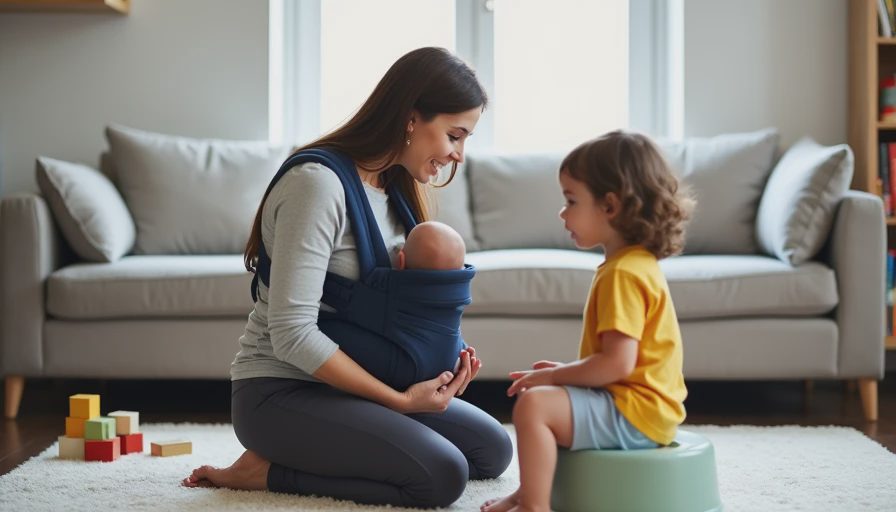
With a baby, these invitations require creativity. If you're feeding the baby, you can say, "When I'm done feeding the baby, we'll go sit on the potty together." If the baby is napping, that's a perfect window. If the baby is in the carrier, you can walk your toddler to the bathroom while wearing the baby. The more you can integrate potty time into your existing rhythm, the less it will feel like a disruption.
Celebrate Every Step, Not Just Success
Potty training is emotional for toddlers. They're learning a brand-new skill, and they need encouragement. So celebrate everything: sitting on the potty even if nothing happens, pulling their own pants down, washing hands afterward, telling you they're wet. Every step counts.
For some toddlers, verbal praise is enough. For others, a few stickers or M&Ms help. The size of the reward doesn't matter — the consistency and enthusiasm do. The message is: You're doing something hard, and I'm proud of you.
When there's a baby in the house, make a point of celebrating your toddler in front of the baby. "Look at your big sibling going potty! The baby thinks you're amazing!" This reinforces your toddler's identity as the big kid and helps counter the feeling of being replaced.
The Practical Setup That Saves Your Sanity
Put a Potty in the Main Living Area
If you spend most of your day in the living room feeding the baby, put a potty chair there too. Yes, it's not beautiful. But when your toddler needs to go, they need to go now, and a potty upstairs might as well be on the moon when you're trapped under a nursing baby.
I recommend at least two potties: one in the bathroom, one in the main living area. Some families also keep a travel potty in the car. The more accessible the potty, the fewer accidents you'll have.
Create a Potty Caddy
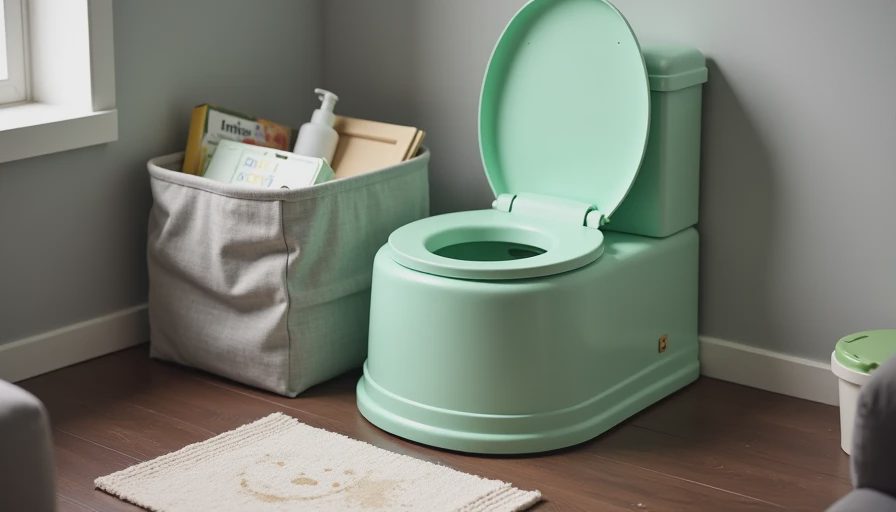
Next to the potty, keep a basket with everything you need: wipes, a spare pair of underwear or training pants, a small wet bag, hand sanitizer, and a book or two for sitting time. This way, you can handle the entire potty process without leaving the room — which means you don't have to choose between the potty and the baby.
Dress for Success
During active potty training, dress your toddler in clothes they can remove quickly. Elastic waistbands, loose shorts, skirts, dresses — anything that doesn't require buttons, zippers, or adult help. You might also let your toddler go without pants during the first week if you're staying home. The fewer obstacles between your toddler and the potty, the better.
One mistake I see often: parents dress their potty-training toddler in adorable but complicated outfits — overalls, button-up jeans, tights under dresses. These are the enemy of potty training. Every second spent wrestling with a button is a second your toddler could be on the potty.
When It All Falls Apart
Potty training with a baby rarely follows a straight line. Expect regressions. Expect days when your toddler refuses to sit on the potty at all. Expect accidents in terrible locations. None of this means you're failing.
The Pause Is Always Available
Here's the truth that changed everything for me: you can stop and try again later. Not as punishment, but as a practical response to real life. If your toddler is fighting you, if the accidents are causing more stress than connection, if the baby's needs are so intense that you can't give potty training any attention — pause.
I know a mother who started potty training her two-and-a-half-year-old three times before it stuck. The first time, her newborn was six weeks old and it was chaos. The second time, her son was in a sleep regression and everyone was exhausted. The third time — six months later — things clicked in a week. She wasn't failing the first two times. She was wisely reading her family's capacity.
Potty training is not a one-shot deal. It's a process that can flex around your family's needs. There's no deadline, no prize for getting there first. Just a child who will eventually learn, and a mother who can choose to make that process as gentle as possible.
Protecting Connection Comes First
If potty training is damaging your relationship with your toddler — if you're both crying, if every potty attempt becomes a power struggle, if you're starting to resent them — stop. The connection is more important than the potty. Always.
A child who feels safe and loved will eventually use the potty. A child who feels pressured and shamed will also eventually use the potty, but at a higher emotional cost. The how matters as much as the when.
I remember snapping at my daughter after an accident that happened right after twenty minutes of sitting on the potty with no result. She looked so ashamed. I knelt down, held her, and said, "I'm sorry. Accidents happen. It's okay." That repair mattered more than any potty success we'd had that week.
The Long View
Your toddler will not go to college in diapers. This phase — the accidents, the interrupted potty sits, the baby crying while you're stuck in the bathroom — is temporary. It will end, probably sooner than you think, and you'll be left with a child who uses the bathroom independently and a baby who is no longer a baby.
In the meantime, be gentle with yourself. Potty training with a baby in the house is genuinely hard, and you're doing it anyway. Some days will be messy. Some days will be frustrating. And then one day, your toddler will run to the potty by themselves, pull down their own pants, and go — and you'll realize you taught them that, even with a baby in your arms.
You do not need a perfect system. You need one that works at 3 a.m. — and at 10 a.m. when your toddler is on the potty and the baby is crying and you're holding it all together with one hand. That system starts with this: lower the pressure, stay connected, and remember that every child learns eventually. Yours will too.
No notes yet — write the first one.