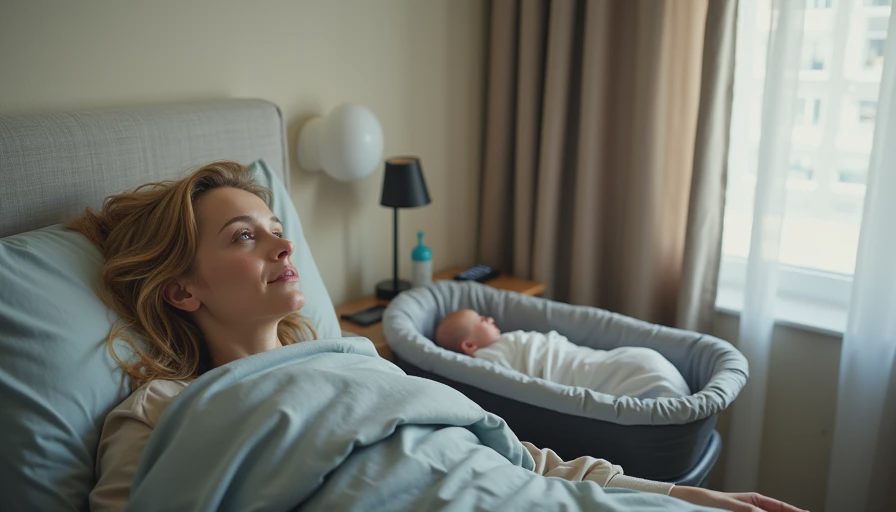
Of all the advice handed to new mothers, "sleep when the baby sleeps" might be the most universally repeated — and the most universally useless. It ranks right up there with "enjoy every moment" and "you'll never sleep again," two other gems from people who've apparently forgotten what those first months actually feel like.
The phrase implies something beautiful: the baby drifts off, you drift off, and the whole house basks in synchronized serenity. What it doesn't account for is the toddler standing next to the crib demanding a snack, the pile of bottles in the sink, the dog that needs to go out, the bleeding nipples that need air-drying, the crushing anxiety that won't let your brain shut off even when the baby is finally asleep, and the simple fact that you are not a robot that can power down at random intervals just because a baby's eyes closed.
I've been both the professional walking into new mothers' homes and the mother herself, lying awake in bed at 2 p.m. while my newborn napped, staring at the ceiling and mentally replaying every mistake I'd made that day. The advice doesn't work because it was designed for a version of postpartum life that doesn't exist. Let's talk about what actually does.
Why This Advice Fails So Many Mothers
You Cannot Sleep on Demand
Human sleep doesn't work like a light switch. You can't just flip yourself into unconsciousness the moment your baby falls asleep, especially if you're running on cortisol and anxiety. New mothers often experience what researchers and clinicians call "tired but wired" — a state where your body is exhausted but your nervous system is too activated to let you sleep. The moment the baby closes their eyes, your brain starts racing: Did I hear a sound? Is the baby breathing? What time is it? How long do I have? Should I shower or sleep? If I fall asleep now and the baby wakes up in twenty minutes, will I feel worse?
That last question is real, by the way. A truncated nap can sometimes leave you feeling worse than no nap at all — groggy, disoriented, and even more exhausted than before. So when someone tells you to "just sleep when the baby sleeps," and you can't, you internalize it as another failure. I can't even get this right, you think. I'm so bad at rest I can't even do it when I'm given permission.
You are not bad at rest. You are a mammal with a nervous system, not a machine with a sleep timer.
You Have Another Child
The most obvious and infuriating flaw in "sleep when the baby sleeps" is that it assumes this is your only child. For mothers with a toddler or older kid at home, the phrase is almost laughable. Your toddler does not care that the baby is napping. Your toddler is not going to quietly lie down next to you and join the nap. Your toddler is going to use the baby's naptime to empty the Tupperware cabinet, demand a snack, ask fourteen questions about why the sky is blue, and attempt to "help" by wiping the baby's face with a used paper towel they found in the trash.
I have a four-year-old daughter and an eleven-month-old son. When my son was a newborn, my daughter's naptime had already disappeared. She was three — too old for a nap, too young to be left unsupervised, and deeply curious about whether the baby could fit in the doll stroller. "Sleep when the baby sleeps" was not an option. "Referee the preschooler while the baby sleeps" was the actual schedule.
You Have a Household That Doesn't Pause
Even if you have only one baby and a partner who takes over everything else, the household still needs things. Laundry doesn't wash itself. Bottles don't clean themselves. Food doesn't materialize. And while I'm a firm believer that most of these things can wait — and should wait — there are some baseline tasks that keep the household functioning enough for everyone to eat and wear clean clothes.
The mother who washes bottles while the baby sleeps isn't failing at rest. She's making it possible to feed the baby in two hours. The mother who folds laundry while the baby sleeps isn't wasting the naptime. She's making sure there are clean burp cloths for the next round of spit-up. These are survival tasks, not indulgences.
What "Sleep When the Baby Sleeps" Is Really Trying to Say
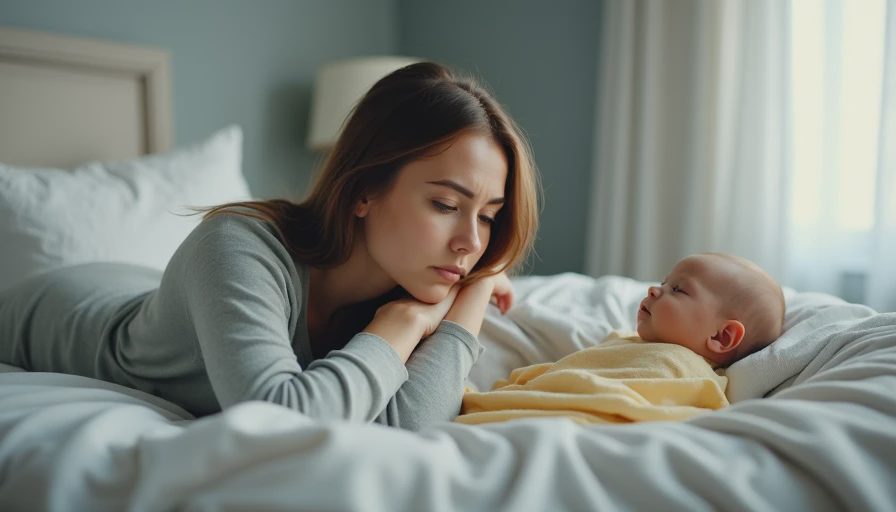
Here's the thing: the advice isn't entirely wrong. It's just terribly phrased. What people mean when they say "sleep when the baby sleeps" is something closer to this: "Lower your standards for everything that isn't survival, and take rest in whatever form you can get it."
That's advice worth keeping. The problem is the sleep part. Because here's what I learned in eight years of postpartum care work and two babies of my own: real rest doesn't always look like sleep. And chasing sleep so hard can actually make the rest you need feel even further away.
Let me give you a different framework. Instead of asking, "Can I sleep when the baby sleeps?" ask yourself: What would make the next hour feel slightly more survivable?
Sometimes the answer is sleep. Often, it's something else.
What Actually Helps When You Can't Sleep
Take "Rest" Instead of Naps
I want you to expand your definition of rest. Rest is not only unconsciousness. Rest is lying on the couch with your eyes closed while the baby sleeps in a safe bassinet next to you. Rest is sitting in a chair with a cup of tea and no one touching your body for ten minutes. Rest is taking a shower — a real one, with soap and warm water and maybe even conditioner — while the baby naps in a bouncer in the bathroom or a partner holds them.
One mother I worked with told me she felt guilty for showering during the baby's naptime because she "should" be sleeping. But her shoulders were so tight from constantly holding a newborn that the warm water released something sleep never could. She came out of that shower a different person. That's rest. It counts.
Use the Nap for the Thing That's Most Depleting You
If you're exhausted but can't sleep, use the baby's nap for whatever is draining you most. For some mothers, that's a shower. For others, it's eating a full meal with both hands free. For still others, it's sitting alone in silence with no one asking for anything.
Ask yourself: What am I most depleted on right now? Is it sleep? Is it food? Is it alone time? Is it the crushing mental load of an unfinished task list? Whatever the answer is, spend the naptime on that. Not on what you "should" be doing — on what you actually need.
Try the "No-Phone Rest"
Here's a small experiment that costs nothing and can change how you feel during those first months. The next time your baby falls asleep and you don't feel like you can sleep, try lying down with no phone. Not "lie down and scroll TikTok." Just lie down. Close your eyes or don't. Stare at the ceiling. Let your brain wander or go blank. Ten minutes of this is worth more than an hour of doom-scrolling.
I know this sounds too simple to matter, but I've recommended it to dozens of exhausted mothers and heard back from enough of them to know it works. The phone is a false rest. It gives your brain something to do, but it doesn't give your nervous system a break. Lying still, even awake, does.
Accept That Some Naps Will Be Short
One of the most liberating things I ever learned as a parent is that a twenty-minute nap is still a nap. It might not feel as restorative as a two-hour sleep, but it's not nothing. If you can catch even fifteen minutes of dozing while the baby sleeps, take it. Don't lie there calculating how much sleep you're "missing out on" if the baby wakes up soon. The calculation is the thief. Whatever sleep you get is sleep you didn't have before.
I used to tell my clients: "Don't do the math. Just lie down." The math — if I fall asleep now and the baby wakes up in twenty minutes, I'll only get eighteen minutes of actual sleep — is just anxiety dressed up as planning. It's not helping you rest. It's keeping you awake.
What Partners and Family Members Can Do
If you're reading this and you're not the sleep-deprived mother — you're her partner, her parent, her friend, her sister — here's what I need you to understand.
When you say "sleep when the baby sleeps," the mother hears: You're not managing your time well. If you just tried harder, you could be sleeping. Your exhaustion is a scheduling problem, not a real problem. That's not what you mean, but it's often what lands. Instead, try one of these:
"I'm taking the baby for two hours. Go do whatever you need — sleep, shower, stare at a wall. I've got this."
"What's the most draining thing on your list right now? Can I do it while the baby naps?"
"I made you a snack. Eat it while the baby sleeps. I'll handle everything else for the next hour."
Action beats advice every time. If you want to help a new mother, don't give her a suggestion she's already heard a hundred times. Give her an hour of time that belongs only to her.
The Honest Truth
With my first child, I did not sleep when she slept. I couldn't. My brain was too loud, my body too tense, and my heart too full of anxiety. I spent her naps pacing, cleaning, crying in the shower, calling my mom, and sometimes just sitting on the kitchen floor eating peanut butter from the jar while staring at the wall.
With my second child, I learned to let go of the sleep obsession. When he napped and I couldn't sleep, I lay on the couch with my eyes closed. I took a shower without apologizing to anyone. I ate a sandwich with both hands. I sat outside on the back step in the sun for five minutes with no phone. None of those things were sleep, but all of them were rest, and they kept me going in a way that the pressure to sleep never did.
So the next time someone tells you to "sleep when the baby sleeps," you can nod and smile and know the truth: you are already doing the best you can with the sleep you have. The goal was never to match your baby's sleep schedule. The goal was to survive this phase with some shred of yourself intact.
You do not need a perfect system. You need one that works at 3 a.m. And that system includes letting go of the myth that you should be sleeping whenever your baby is. Rest looks different for everyone. Find yours, and don't apologize for it.
Start with the part that makes tonight easier. Even if that means lying down with your eyes open for ten minutes while the baby sleeps beside you. That counts. You count.
No notes yet — write the first one.